
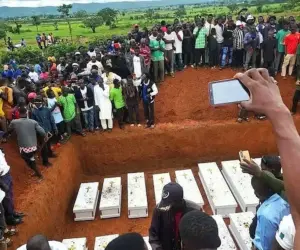
For Immediate Release (Westlake Village, CA) — As reported by Christian Solidarity International (CSI), at least 250 people were killed in Fulani militant attacks in Nigeria’s Middle Belt in the month of July. The latest figures come after U.S. President Donald Trump asserted that the widespread slaughter of Christians was over and withdrew 200 American troops from northeastern Nigeria.
According to the International Society for Civil Liberties and Rule of Law (Intersociety), an estimated 2,550 Christians were killed and another 2,800 abducted across Nigeria between January and June 2026. During the same period, 1,050 Muslims were killed and 1,150 abducted. The report also states that approximately 300 churches were destroyed or abandoned, 10 Christian pastors were killed, another 10 were abducted, and around 800 Christian women and children were forcibly converted to Islam while in captivity.
In an overnight attack on July 27, suspected Fulani Islamist militia attacked Naridon (Kizakoro) village in Kauru Local Government Area of Kaduna State. Thirty people were killed, including 22 members of the same family. Seven others were injured, while two homes and three shops were destroyed.
As in previous attacks, President Bola Ahmed Tinubu announced that he had “directed the Armed Forces, the Nigeria Police Force and relevant intelligence agencies to intensify operations across the affected areas to swiftly apprehend the perpetrators, secure the release of abducted persons and restore normalcy to the community.”
However, many local leaders argue that official responses remain largely reactive.
In an open letter dated July 27 to the Kaduna State Commissioner of Police, copied to Governor Uba Sani, the Southern Kaduna People’s Union (SOKAPU) insisted that, “The current incidents of violence demand a sharp departure from reactive responses to aggressive and proactive law enforcement.”
Plateau State also has experienced repeated attacks throughout 2026. On July 11, nine members of the extended family of Reverend Ezekiel Dachomo were killed in what was described as a targeted attack. Rev. Dachomo has become one of Nigeria’s most outspoken Christian leaders, drawing international attention to the growing number of mass graves following attacks on Christian communities in Plateau State. His advocacy reportedly reached President Donald Trump, but it has also resulted in death threats from radical Islamist groups.
On July 23, U.S. Assistant Secretary of State for African Affairs Frank Garcia condemned the killings and said the United States remained committed to working with the Nigerian government “to combat terrorism, counter violent extremism, and ensure that Christians and all Nigerians can live and practice their faith freely without fear of violence or persecution.”
In November 2025, Trump warned, “If the Nigerian Government continues to allow the killing of Christians, the USA will immediately stop all aid and assistance to Nigeria and may very well go into that now disgraced country, ‘guns-a-blazing,’ to completely wipe out the Islamic Terrorists who are committing these horrible atrocities.”
Although the United States deployed 200 troops to northeastern Nigeria to support operations against Boko Haram, those forces were withdrawn in June 2026 despite continuing attacks on military installations, communities, and civilians.
In explanation, General Dagvin Anderson of U.S. Africa Command (AFRICOM) said, “We have withdrawn much of our forces that were just there for that operation,” while stressing that the United States would continue intelligence sharing and other forms of security cooperation requested by Nigeria.
On June 26, Trump suddenly declared the attacks on Christian communities over. “We recently struck Nigeria and largely ended the slaughter of great Christian populations.”
Trump then wrote to President Tinubu on July 6 praising his “decisive leadership” and commending his efforts to address “the violence affecting Christian communities.”
Trump’s assessment was disputed by Joseph Hayab, Chairman of the Christian Association of Nigeria (CAN) for the 19 northern states and the Federal Capital Territory. “The right people who should tell whether Trump has succeeded should be Nigerian Christians or Northern Christians, not Trump himself.”
In mid-July, Representatives Riley Moore of West Virginia and Jeff Steube of Florida introduced a bill in the U.S. House of Representatives calling for foreign governments and “bad actors” to be held accountable for the persecution of people of faith.
The measure passed by a narrow 217-209 margin and proposes reducing U.S. assistance to Nigeria until effective action is taken to protect Christian communities affected by religious violence.
Frustration with the government’s inability to provide security has led to increasing calls for lawful self-defense. CAN has urged Nigerian Christians to organize for their own protection. “Unless and until all of us start organizing ourselves to chase those who have been chasing us, they will torment us for the next 200 years,” Joseph Hayab said.
For many Christians in Nigeria, the question is no longer whether the violence will continue, but whether the Nigerian government or its international partners will adopt measures capable of stopping it.







![Evan Craft – Verde [feat. Andy Rivero] (Vídeo Oficial)](https://cmaddict.com/wp-content/uploads/2026/08/Evan-Craft-1024x1017.webp)




Leave a Reply